


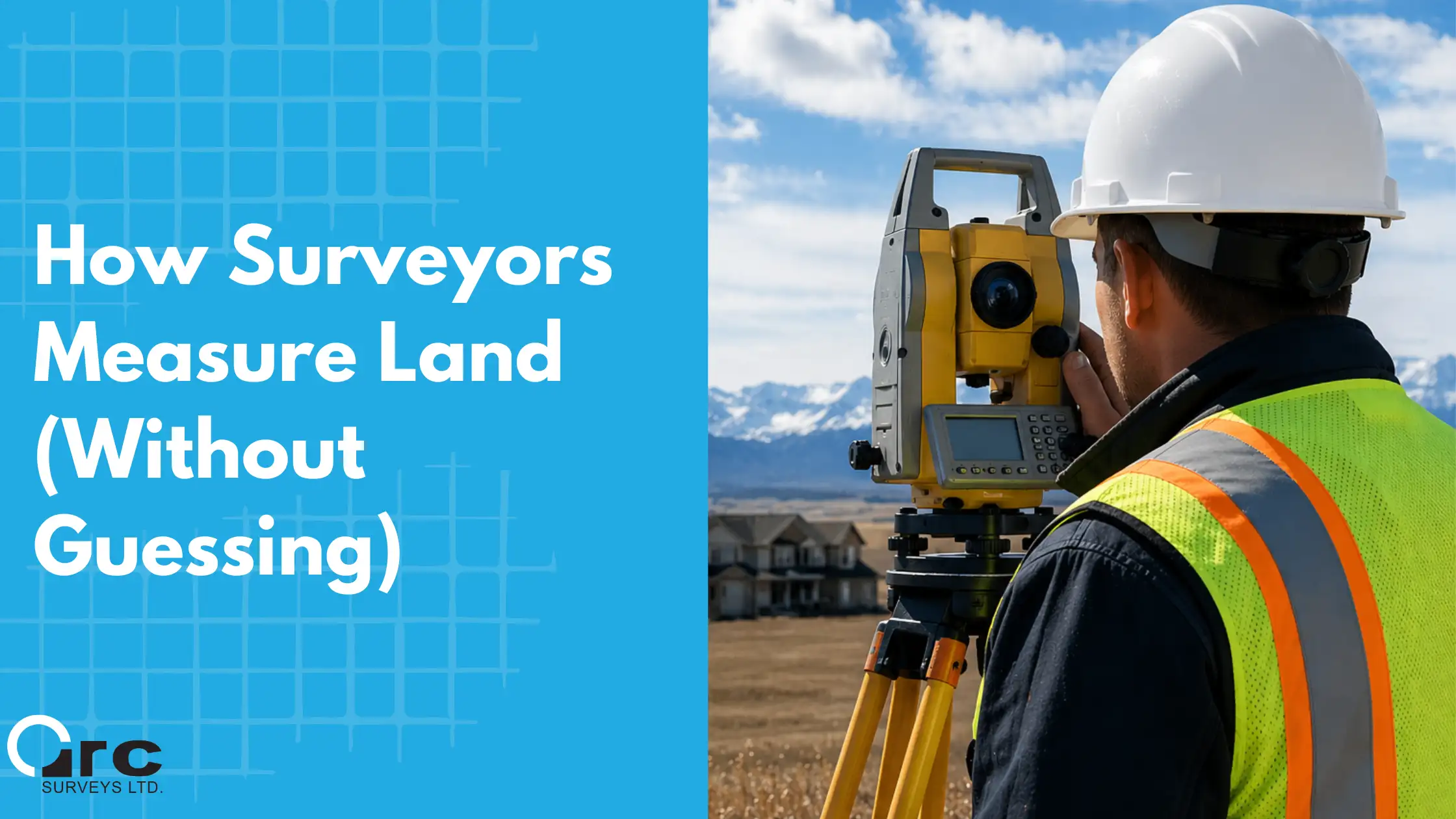
You’ve probably seen a surveyor at work, tripod set up on the street, walking the lot with a measuring rod. From the outside, the job can look straightforward. But what’s actually happening is more layered than it appears. Land surveying is a structured, evidence-based profession rooted in legal documentation, precise measurement, and years of professional training.
Whether you’re buying a home, planning an addition, or navigating a boundary dispute, understanding how surveyors work and why the process is legally reliable can save you time, money, and serious headaches down the road.
It Starts With Records, Not the Field
Before a surveyor sets foot on your property, they’ve already done a significant amount of work. Boundaries are defined first by legal documentation not by fences, hedges, or where your neighbour says the line is.
That research might typically involves reviewing:
- The parcel’s legal description
- Registered plans held by Alberta Land Titles
- Historical survey plans linked to the property
- Subdivision or condominium plans, where applicable
- Easements, rights-of-way, and other registered interests.
Survey Control: The Framework That Keeps Everything Accurate
Modern land surveying doesn’t happen in isolation. Measurements need to connect to a larger reference framework and that’s where survey control comes in.
Survey control points are known, verified locations that allow a surveyor to position your property boundaries accurately within Alberta’s provincial coordinate system. This creates consistency across:
- Property lines and lot boundaries
- Municipal mapping and cadastral records
- Registered plans filed with Alberta Land Titles
- Infrastructure, utilities, and public works
Without survey control, measurements are local guesses with no broader context. With it, survey results are repeatable, verifiable, and legally defensible, which matters enormously if your property ever becomes the subject of a dispute or development application.
The Tools Surveyors Use and What They Actually Do
Surveyors use instruments purpose-built for precision. These aren’t measuring tapes and compasses. They’re highly engineered tools that work together to locate points in three-dimensional space.
Total Stations
A total station is an electronic instrument that measures horizontal angles, vertical angles, and distances using an infrared or laser. These three measurements are combined to calculate the precise location of any point, a boundary corner, a building wall, or a fence post, in space.
Modern total stations are capable of millimeter-level precision in the right conditions, and their readings are recorded digitally to eliminate transcription errors.
Survey-Grade GNSS / RTK
Global Navigation Satellite Systems (GNSS) — which include GPS and other satellite constellations like GLONASS, Galileo, and BeiDou, power the other major tool in a surveyor’s kit. But survey-grade GNSS is not the same as your phone’s GPS.
Survey-grade receivers use Real-Time Kinematic (RTK) correction: A technique where the receiver compares its satellite data to a fixed reference station in real time, correcting errors on the fly. The result is centimeter-level positioning accuracy, compared to the 3–5 meter error typical of a smartphone.
RTK is ideal for large or open sites, while total stations are preferred in dense urban environments or where sub-centimeter precision is required.
Survey Pins and Monuments
Physical evidence matters just as much as technology. Original boundary monuments are among the most important pieces of evidence a surveyor can find.
Surveyors search for this evidence systematically, and finding an undisturbed original pin is often the strongest confirmation a boundary position is correct.
Why Two Surveys of the Same Property Can Look Different
If you’ve compared an older survey to a newer one on the same property and noticed differences, you’re not alone and there’s a clear explanation.
Surveys aren’t revised opinions. They reflect the state of evidence at the time they were completed. A more recent survey might differ from an older one because:
- Improved measurement technology has refined the position
- Original monuments were recovered that weren’t found previously
- Adjacent properties were subdivided or consolidated, changing the context
These differences almost always represent progress not error. Modern surveys typically resolve uncertainty, rather than introduce it.
Beyond the Lot Lines: What Else Surveyors Measure
Measuring the property boundary is only part of what shows up on a completed survey. Surveyors also locate and precisely measure the improvements on your property everything that’s been built or placed on the land.
This includes:
- The house, garage, and any detached structures
- Decks, stairs, and covered patios
- Fences, retaining walls, and hedges at the boundary
- Driveways, parking pads, and hard landscaping
This information is central to a Real Property Report (RPR) the legal document that shows how your property’s improvements relate to its boundaries and comply with municipal requirements. In Edmonton, an RPR is typically required when a property changes hands and is often a condition of sale.
Encroachments: Calculated Facts, Not Assumptions
An encroachment happens when a structure a fence, a deck, a garage extends past a legal boundary or into a registered easement. Discovering one can feel alarming, but the surveyor’s job is simply to establish the facts.
The process is methodical:
- Re-establish the legal boundary from records and evidence
- Measure the exact position of the structure in question
- Calculate the overlap distance to the nearest centimeter
What happens next: negotiation, removal, an encroachment agreement, is a decision for the property owners, municipality, or legal professionals involved. The surveyor’s role is to supply accurate, documented measurements. Nothing more, nothing less.
Why Professional Standards Exist And Why They Matter to You
Land surveys directly affect who owns what, what can be built, and whether a transaction can proceed. That’s why Alberta Land Surveyors are governed by professional legislation and held to documented standards of practice.
Land Survey must be:
- Grounded in evidence, not assumptions or estimations
- Documented with clear methodology that can be reviewed
What This Means for Property Owners
Whether you’re buying, building, or resolving a dispute, a few things are worth keeping in mind:
- Your fences are not your boundaries, the legal description is
- Accuracy requires both archival research and physical verification in the field
- Survey results are reliable because they can be independently reproduced
- Getting a professional survey early prevents delays, disputes, and expensive corrections
If you have questions about your property lines, setbacks, or need an RPR for a pending sale or development application, a licensed Alberta Land Surveyor is the right starting point, not a neighbour’s recollection or a satellite image.
Ready to Get Your Survey Done Right?
Whether you need a Real Property Report for a pending sale, a boundary survey before you build, or answers about an encroachment concern, Arc Surveys delivers accurate, legally defensible results across Edmonton and Alberta.
Get a free quote at ArcSurveys.ca no obligation, no guesswork.